Understanding is progress
Learning tongues, not stacking levels, is what actually moves you forward. Knowledge is the progression system.
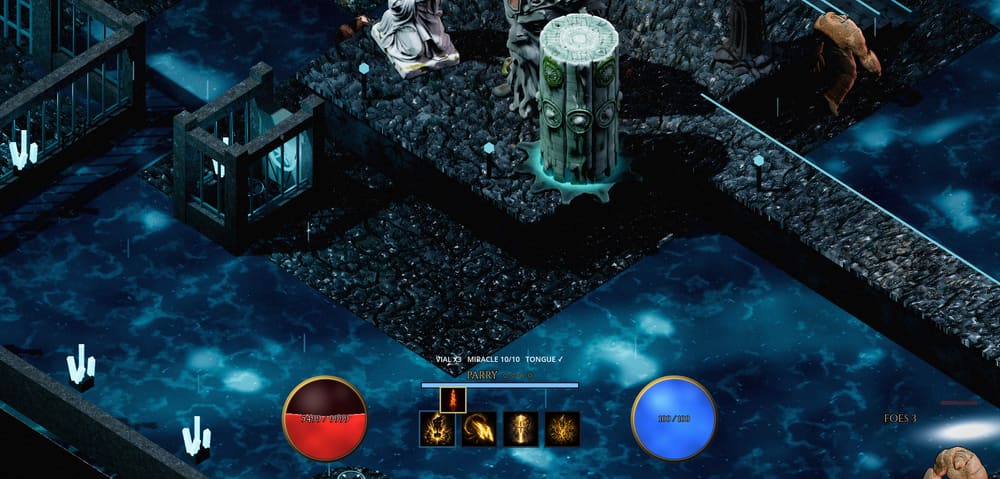
An isometric action roguelite about a tower nobody ever finished climbing. You do not win by killing. You win by understanding.
Every strike deals damage only on the frame where the contact is visible. Animations commit: if you attack, you finish the attack. Mashing never skips the recovery. It is combat that punishes noise and rewards reading.
Defence is not a permanent block button, it is a window. Hit the moment and the exchange flips; miss it and you pay. The whole game rests on that window.
The enemy warns you before it strikes. The problem is that it warns you in a language you do not speak.
That is the idea holding the game together. Every biome in the tower speaks its own tongue, and the attack warnings — the tells that precede each blow — are written in it. While you do not understand it, enemies look unpredictable. Once you learn it, those same enemies become readable and the fight changes without you raising a single stat.
Learning tongues, not stacking levels, is what actually moves you forward. Knowledge is the progression system.
Every map has a bell. Ringing it in the rhythm of the parry is what grants you mastery of that biome's tongue.
Skill weighs more than permanent progression. There is no way to grind your way past the learning.
The reference is the tower of Babel: a build left half-finished when its builders stopped understanding each other. Here the confusion of tongues is not set dressing, it is the lock. Force does not open the tower; comprehension does. You climb by recovering what was lost when nobody could speak to anybody again.
Each stratum has its own character and its own tongue: the Foundry, with its lava pit and terraces; the flooded Cisterns; the Scriptorium; the Hanging Gardens; the Lower Archive. No two are walked the same way.
The floors are not hand-written one by one. The engine generates them from rules, and every map passes a set of automated gates before I ever get to see it: no empty zones, every jump reachable, the walkable box intact.
Single player. Offline. Replayable. Deterministic. One protagonist, with sword, shield, fists and kicks: variety comes from styles, not from a roster of characters.
Not live service, not gacha, not open world, not multiplayer, not pay to win. No backend, no telemetry and nothing to wait for before you can play.
One rule orders the whole project: anything that can be data must not be code. Enemies, biomes, rooms, spells and palettes live in versioned, validated JSON files. The engine reads them; it never carries them inside.
That has a concrete consequence: adding an enemy, a biome or a new tongue does not touch engine code. And if a content file comes in wrong, it fails immediately and loudly, instead of degrading silently until something breaks far from the cause.
I have spent years operating platforms where a mistake is paid for dearly and at 3 a.m. When I started this game I did not change discipline, only domain.
Thirteen documents — vision, domain, architecture, data rules, vertical slice scope — written before any code existed. When two decisions conflict, the higher-level document wins. No hallway debates.
No content embedded in code. Every line written to represent content counts as debt until it is justified in writing.
Every map goes through automated validation before I look at it. If one fails, the map does not exist yet. It is the same standard by which a change gets approved in production.
No gate tells you whether a jump feels right. That is settled by walking the map. Offscreen probes do not reproduce what shows up in the real window: I learned that debugging a map that looked black and was in fact crashing.
On AI: I use AI assistance for part of the art and the development tooling. The design, the architecture, the rules and the code are mine, and I am saying it here before anyone has to ask.
Captured from the game in development, with the real combat interface. None of this is a promotional render.
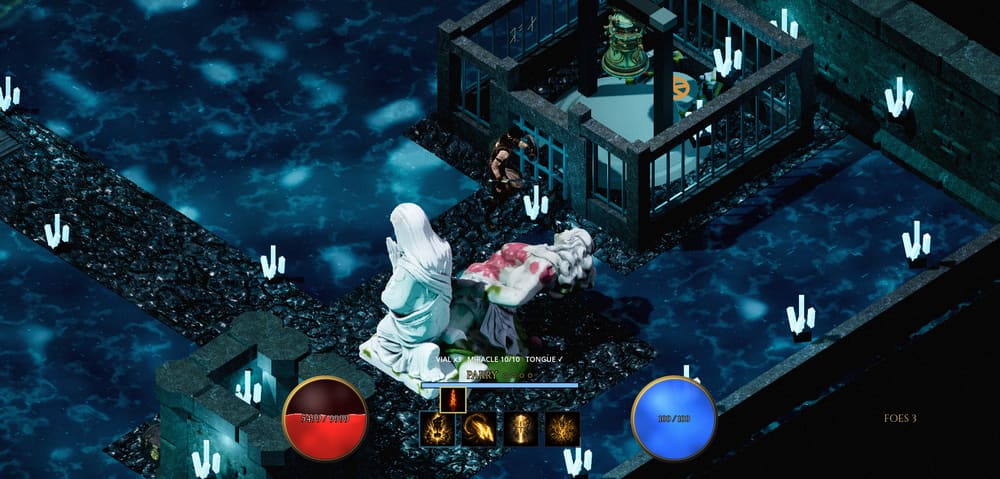
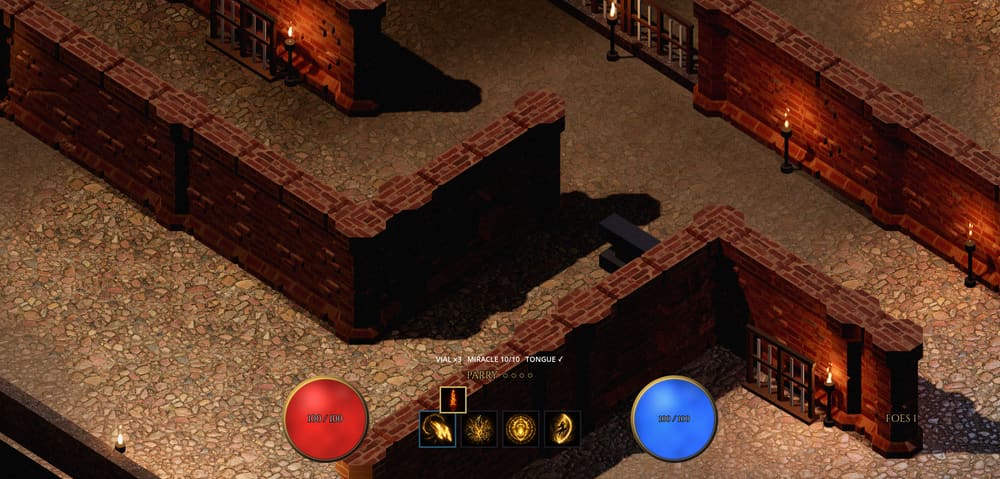
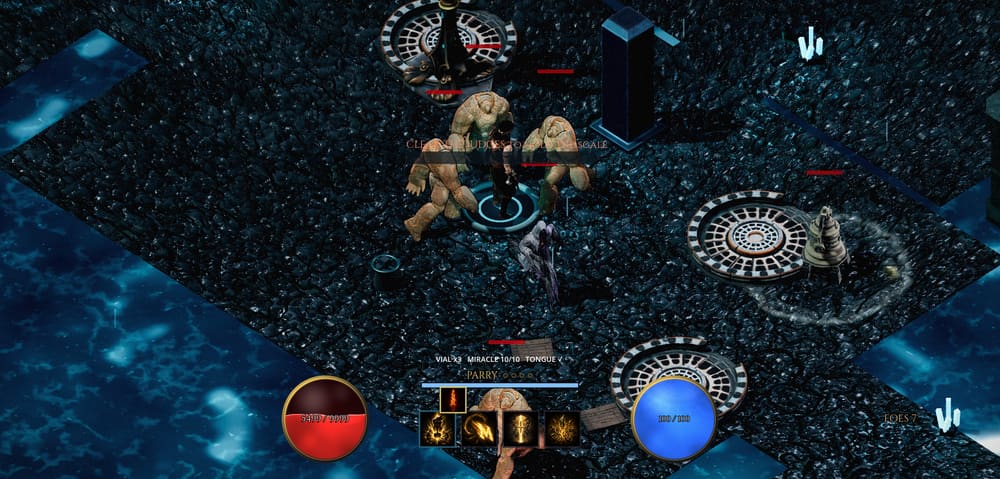
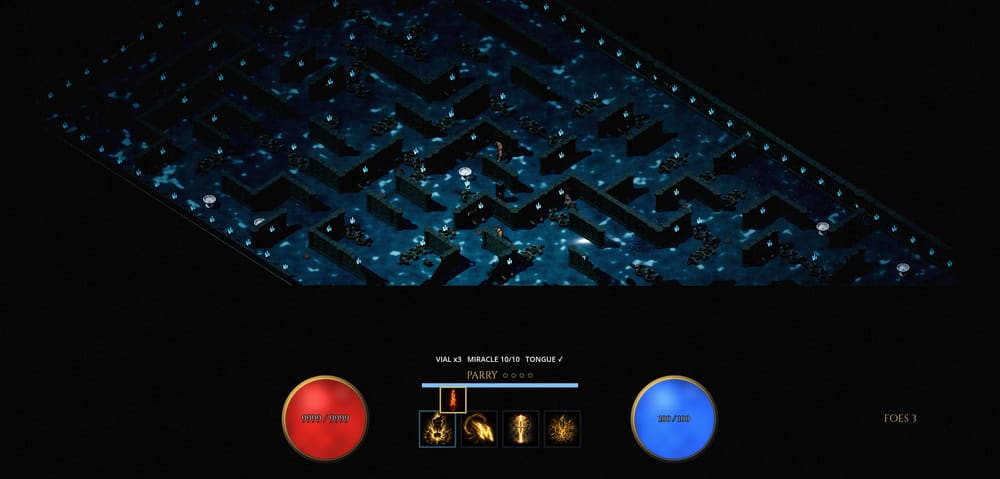
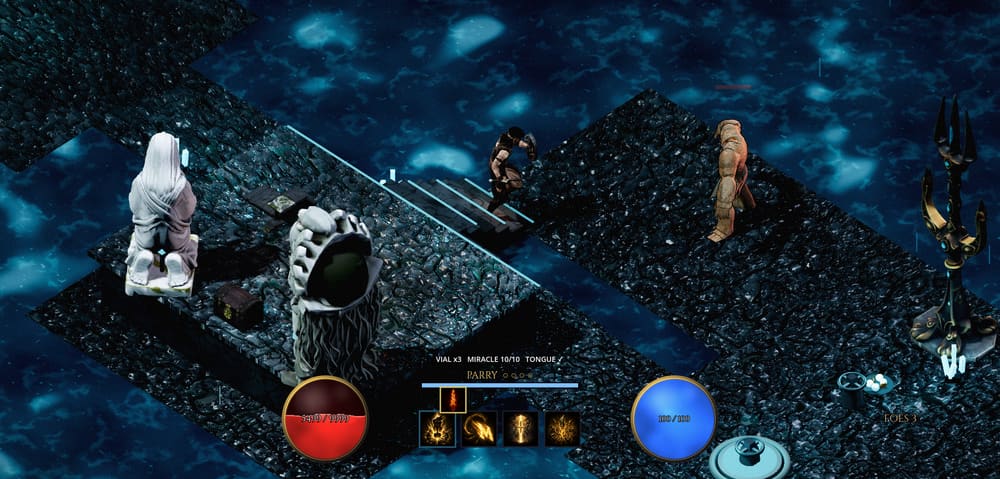
The game is in active development: part of the art is provisional and what you see here will change.
I would rather show the trailer once the demo plays start to finish, not before. Leave your email below and you get it the day it drops.
The Steam page is not published yet. It is the next step for the project, and when it exists, the first notice goes out here.
Your email, only for this. No spam and no sharing with third parties. Unsubscribe any time with one click. Data controller: Jorel del Portal / DEL PORTAL TECHNOLOGIES S.A.C.